
Environmental Commitment
We are committed to enhancing environmental protection and addressing climate change as integral components of our operational strategy. We view these challenges as opportunities to transform our practices and contribute positively to the environment. Our approach includes rigorous climate-related risk assessments to inform our strategy, align our investment decisions, and ensure our actions are risk-aware.
Environmental Management
Danaos has developed a robust and integrated Environmental Management System that reflects its long-standing commitment to minimizing environmental impacts across both vessel operations and shore-based activities. Our Environmental Management System integrates energy efficiency, carbon reduction, sustainable procurement and environmental performance monitoring to ensure we operate responsibly and contribute to a lower-carbon maritime sector. Our Environmental Management System is supported by internationally recognized certifications, including:
ISO 14001 - Environmental Management
ISO 50001 - Energy Management
ISO 45001 - Occupational Health & Safety
IMO SEEMP (I, II & III) - Ship Energy Efficiency Management Plan
These frameworks together form a cohesive foundation for responsible operations, environmental stewardship and workplace sustainability.
Danaos has implemented a range of sustainability practices to reduce operational impact, both at sea and ashore:
- 50% of electricity in our shore-based facilities is sourced from renewable energy, directly reducing Scope 2 emissions. These emissions are reported annually as part of our carbon accounting and we are actively increasing the share of renewable energy to further decarbonize our operations.
- Scope 3 emissions from logistics and third-party services are monitored through data sharing with logistics providers, enhancing transparency and enabling data-driven improvements across the value chain.
- Waste reduction is a key focus. Onboard waste compactors minimize landfill contributions, while our office operations are largely paperless, supported by digital document management systems and automated workflows.
- Sustainable procurement practices are embedded to ensure environmental criteria are considered in sourcing processes.
Our environmental policy prioritizes the retrofitting of existing vessels with energy-efficient solutions, wherever feasible. This is a critical component of our strategy to reduce emissions and improve the carbon footprint of the fleet.
All newbuildings are methanol-ready and ammonia-ready providing future fuel flexibility and aligning with IMO decarbonization targets, helping to future-proof Danaos’s fleet. In the near term, biodiesel serves as a viable alternative fuel. All vessel engines are capable of operating on biofuels, ensuring compliance with FuelEU Maritime and other evolving regulatory frameworks.
A core pillar of our strategy involves close collaboration with charterers to optimize vessel performance, through:
- Speed and routing optimization
- Deployment of digital performance monitoring tools
This cooperation ensures that operational efficiency contributes meaningfully to emissions reductions and overall fleet sustainability.
Fleet Energy Management & Operational Efficiency
Danaos has prioritized energy management since 2012 with the implementation of the Ship Energy Efficiency Management Plan (SEEMP) across the entire fleet. This framework supports the continuous monitoring and optimization of ship energy performance, encouraging the adoption of innovative technologies and operational practices. From 2015 onwards, Danaos also adopted ISO 50001, further strengthening onboard energy performance systems.
A broad range of energy optimization measures have been implemented onboard, including:
- Energy-saving technologies and practices: Optimal ballasting, Auxiliary engine load management, Auxiliary boiler in auto mode, A/C controlled use, pumps and fans efficiency and lighting.
- Annual crew training and onboard energy audits.
- Quantitative assessments using KPIs like the Power Efficiency Index to evaluate energy use onboard.
Danaos maintains strong environmental compliance through regular audits and third-party verifications. More specifically, according to our certification scope (i.e. total 4 vessels are certified), one (1) ISO 50001 external verification was carried out during 2025. Regarding SEEMP, all managed vessels are audited each year. Therefore, a total of 105 SEEMP internal energy audits were carried out during 2024. Also, one (1) ISO 14001 external shipboard verification was carried out during 2024, and our Office passed external ISO 14001/45001/50001 audit in September 2025 conducted by DNV and received relevant certification.
The SEEMP Part III is reviewed every three years, as required by the IMO. If a vessel does not meet the regulatory carbon intensity indicators (CII), a Corrective Action Plan (CAP) is submitted, reviewed and approved to ensure regulatory compliance.
To conclude, Danaos Environmental Management System is a key pillar of its ESG strategy, supporting the company’s commitment to low-carbon operations, regulatory compliance, resource efficiency and employee well-being. By leveraging a suite of international standards (ISO 14001, 50001, and 45001), digital tools and performance metrics, Danaos ensures that both its fleet and office operations align with global sustainability goals and contribute meaningfully to the maritime industry’s environmental transition.
Water Efficiency Management
Danaos is committed to responsible water use across its fleet through a comprehensive Water Efficiency Management Program designed to reduce environmental impact, optimize resource use and support global water conservation efforts.
All vessels in our fleet are self-sufficient in freshwater production, equipped with onboard Fresh Water Generators (FWGs) that use engine heat to distill seawater into freshwater. As a result, the majority of freshwater consumed onboard is produced internally, significantly minimizing reliance on external water supplies. Any necessary replenishment is mainly conducted in ports located outside water-stressed areas, ensuring minimal impact on local communities and ecosystems.
To maintain water quality and crew health, Danaos conducts freshwater analyses in accordance with MLC (Maritime Labour Convention) standards, with testing frequencies and sample data tracked and disclosed in our ESG reporting. Furthermore, quantities of freshwater supplied externally are also monitored and reported, reinforcing transparency and data-driven performance. Operational efficiency is supported through our Planned Maintenance System (PMS), which ensures proper functioning of freshwater systems. Additionally, we have installed vacuum-type toilet systems on the majority of existing vessels and all newbuilding vessels, reducing water consumption and lowering sewage system loads.
Danaos also addresses water protection through:
- Bilge water treatment systems (OWS) compliant with MARPOL regulations
- Ballast Water Treatment Systems (BWTS) on all vessels, ensuring full compliance with both the IMO Ballast Water Management Convention and U.S. Coast Guard requirements
- Crew training on ballast water management
- Use of antifouling (A/F) paints free of organotin compounds and cybutryne, in compliance with international environmental standards (validated by vessel A/F certificates).
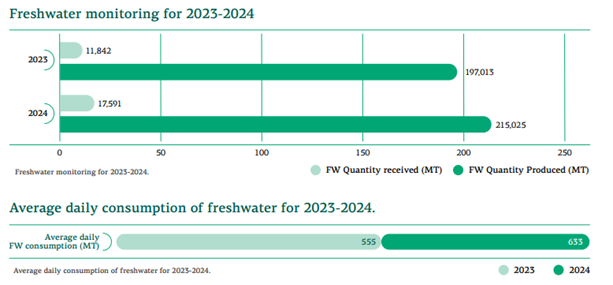
Recognizing the growing global concern around water scarcity, Danaos has implemented a structured program to monitor and report freshwater consumption across both fleet and shore-based operations. Water use at our headquarters has been actively monitored since 2023, and in 2024, this initiative was expanded to cover all office locations. Using the WWF Water Risk Filter Tool, we conducted a comprehensive physical water risk assessment across our global offices considering water availability and physical risk. The results confirmed that none of our sites are located in high water risk areas. To support transparency and long-term planning, historical consumption data is compiled for trend analysis and included in our public sustainability reporting. In addition to tracking daily average consumption per vessel, Danaos correlates total freshwater use with fleet size and growth projections, acknowledging that total demand may increase as the fleet expands.
By proactively managing water resources, Danaos not only reduces operational costs and environmental liabilities but also enhances its resilience to future water-related regulations and aligns with global sustainability expectations.

Biodiversity
Danaos recognizes the vital role of healthy marine ecosystems in global sustainability and the resilience of our industry. Our operations are designed to minimize biodiversity impacts through proactive management of environmental risks and alignment with international conventions and emerging disclosure frameworks.
Our Commitment and Practices
We have adopted a comprehensive set of measures to protect biodiversity and protect marine ecosystem across our operations:
- Minimizing Hazardous Materials: In line with our environmental policy, all Danaos vessels are coated exclusively with antifouling paints that are free of organotin compounds and cybutryne, eliminating substances known to harm marine life.
- Inventory of Hazardous Materials (IHM): All vessels maintain an IHM, ensuring accurate identification, recording, and control of potentially hazardous substances throughout the vessel lifecycle.
- Ballast Water Management: We fully comply with the IMO Ballast Water Management Convention, operating certified treatment systems on all vessels to prevent the transfer of invasive aquatic species.
- Marine Species Protection: Using our advanced analytics and route-monitoring system, Danaos continuously assesses vessel transits within or near ecologically sensitive areas and designated “Whales Initiative” zones. We report the number of vessel days spent in these areas and implement mitigation measures, including voluntary speed reductions and route adjustments, to minimize ecological disturbance.
- Site Footprint: Danaos’s shore-based facilities are not located within legally protected natural reserves, resulting in no direct biodiversity impact from land-based operations.
- Waste and Recycling Management: We adopt strict waste segregation, recycling, and ship recycling practices in compliance with international standards, ensuring environmentally sound material recovery and disposal.
To strengthen our environmental governance, Danaos is developing a Nature-related risk management process aligned with the Taskforce on Nature-related Financial Disclosures (TNFD) framework. This initiative will enhance our ability to identify, assess and manage biodiversity dependencies, risks and opportunities across our operations and supply chain. Each category outlines the associated operational impact, timeframe and mitigation actions implemented to safeguard marine ecosystems while supporting operational efficiency and regulatory compliance. 👉 View our Nature-Related Risks and Opportunities Table here.
Climate Risk Management
We recognize the importance of adhering to the recommendations of the Task Force on Climate-related Financial Disclosures (TCFD). This involves categorizing, managing, and reporting climate-related risks, including both physical and transition risks. Our strategy reflects a comprehensive approach to climate risk management.
Danaos Low Carbon Transition Plan (LCTP)
Published in 2022 and continuously updated, the Danaos Low Carbon Transition Plan (LCTP) outlines our commitment to climate action and decarbonization. Our strategy not only meets but exceeds the International Maritime Organization (IMO) targets. The LCTP is designed to align with the 1.5°C pathway and adheres to internationally recognized goals for both short-term and long-term environmental performance. We are also collaborating with the Science Based Targets initiative (SBTi) to integrate sectoral trajectories for the shipping industry, aligning our emission reduction efforts with these newly established guidelines.
Alignment with Global Standards
Our environmental vision aligns with targets beyond the IMO's, including the Sustainable Development Scenario (SDS) and Nationally Determined Contributions (NDC) under the United Nations Framework Convention on Climate Change (UNFCCC). This alignment underscores our commitment to environmental stewardship and sustainable practices.
Decarbonization Pathways
Danaos is committed to achieving carbon neutrality by 2050 through a dual-path strategy that balances immediate efficiency gains with long-term transformation:
- Optimizing the Existing Fleet: Enhancing the operational and technical efficiency of our current vessels to reduce emissions and improve fuel performance.
- Transitioning to Zero-Carbon Vessels: Expanding our fleet with next-generation ships designed to operate on zero-carbon fuels.
Our newbuilding program includes 25 container vessels ranging from 5,900 to 9,200 TEUs, all designed with flexibility to accommodate alternative fuels, including methanol and ammonia, as these options become commercially viable.
In parallel with our fleet optimization and newbuilding initiatives, Danaos is advancing a balanced approach to fuel transition. Recognizing the current limitations in biofuel availability and supply across key ports, we are taking practical steps to integrate biofuels where feasible. In alignment with the FuelEU Maritime Regulation, we have set a target for approximately 11% of the fuel consumed within the EU to be biofuels, supporting compliance with the regulation’s greenhouse gas (GHG) intensity reduction requirements.
Where biofuel supply is not arranged by the charterer, Danaos will ensure compliance through the FuelEU pooling mechanism, providing flexibility across our fleet. Given existing supply constraints, and to minimize unnecessary operational burden, biofuel consumption will be limited to the minimum necessary to achieve compliance, ensuring a pragmatic, efficient and regulation-aligned approach to meeting our environmental commitments.
Commitment to IMO 2030 Targets
We are dedicated to meeting or surpassing the IMO's 2030 target of a 50% reduction in carbon intensity compared to 2008 levels, with a long-term aim of achieving carbon neutrality by 2050. We strive to reach these goals ahead of schedule, subject to technological advancements and shipyard availability.